
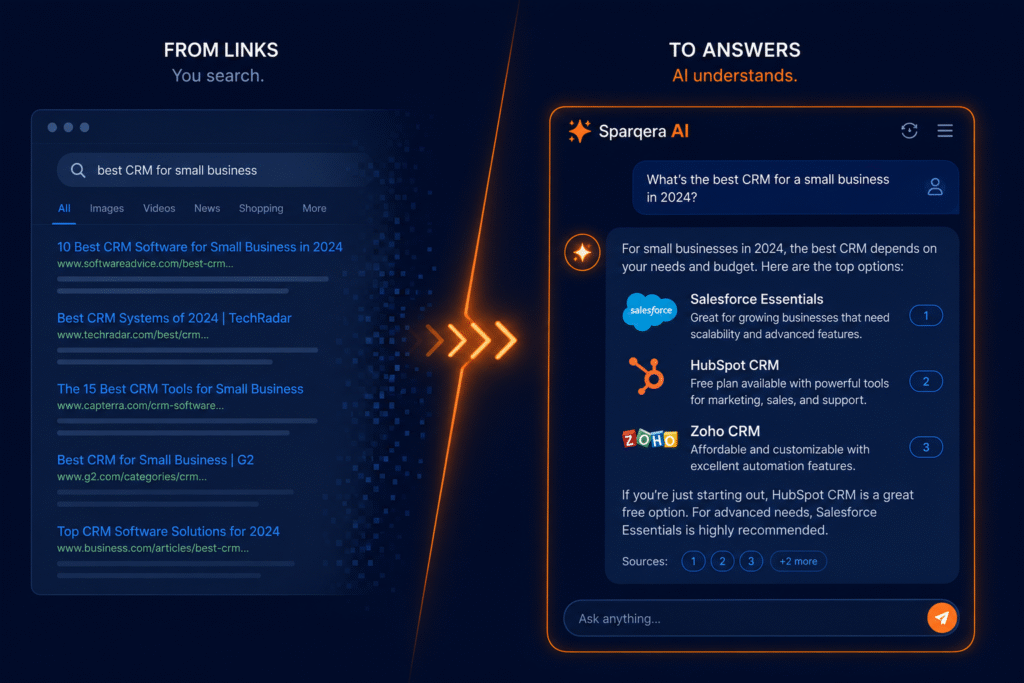
The ten blue links that defined the internet for three decades are fading into history. If your marketing team is still chasing keyword rankings and monthly search volume, you are optimizing for a web that no longer exists.
To rank in AI search engines in 2026, brands must transition from keyword optimization to Generative Engine Optimization (GEO) by securing independent third-party consensus, structuring data with advanced JSON-LD schema, and establishing their brand as a verified entity within Google’s Knowledge Graph.
The shift is abrupt, and it is hurting businesses that rely on historical organic search traffic. According to a 2024 industry tracking report by BrightEdge, AI Overviews and generative answers now appear for more than 80% of high-value commercial and informational search queries.
The catch is simple: when an AI engine answers a user’s question directly on the search page, the user has no reason to click through to your website. This guide outlines exactly how to adapt.
📌 Key Takeaways
SEO is now GEO: Generative Engine Optimization focuses on optimization for Large Language Models (LLMs) rather than legacy search indexes.
Consensus is the new PageRank: AI search engines cross-reference information across multiple sources to establish facts. If the web doesn’t agree on your brand, the AI won’t recommend you.
ToFu content is dead: Basic informational blog posts are easily synthesized by AI. Your content strategy must pivot to original research, proprietary data, and expert opinion.
Feed the crawlers, don’t block them: Blocking AI bots in yourrobots.txtfile is digital suicide. If the models can’t read your site, your brand ceases to exist in conversational search.
Why is Traditional SEO Failing in 2026?
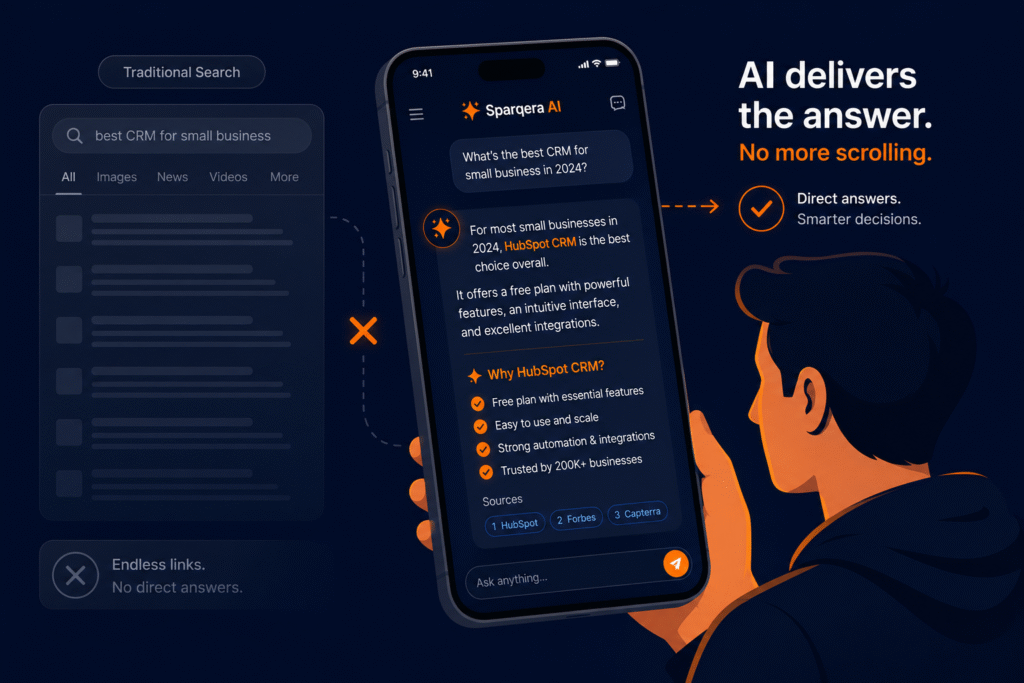
Traditional SEO is failing because search engines are transitioning from index directories into direct answer engines that synthesize information on the fly, resulting in a massive rise in zero-click searches.
For years, the goal of search engine optimization was to rank first on a Search Engine Results Page (SERP). You researched keywords, wrote a 1,200-word article, built backlinks, and waited for the clicks to roll in.
That playbook is broken. Today, when a user queries Google, Google Gemini processes the search intent and presents a comprehensive AI Overview at the top of the screen. The user gets their answer in five seconds without ever leaving the search page.
[Traditional Search] ---> Keyword Query ---> Search Index ---> List of Links ---> User Clicks to Site

[AI Search (2026)] ---> Conversational Query ---> RAG Pipeline ---> Direct Answer ---> Zero-Click (User stays)
Analysis from SparkToro and Similarweb reveals that over 60% of mobile searches now result in zero clicks. As virtual assistants and conversational agents become the primary interface for the web, traditional search engine volume is projected to drop by 25% by 2026, according to a widely cited Gartner search volume decline prediction.
This does not mean search is dead, but it does mean the era of easy informational traffic is over. Keyword stuffing, low-quality guest posting schemes, and hollow content scaling are officially obsolete.
What is Generative Engine Optimization (GEO) for AI Search Engines?
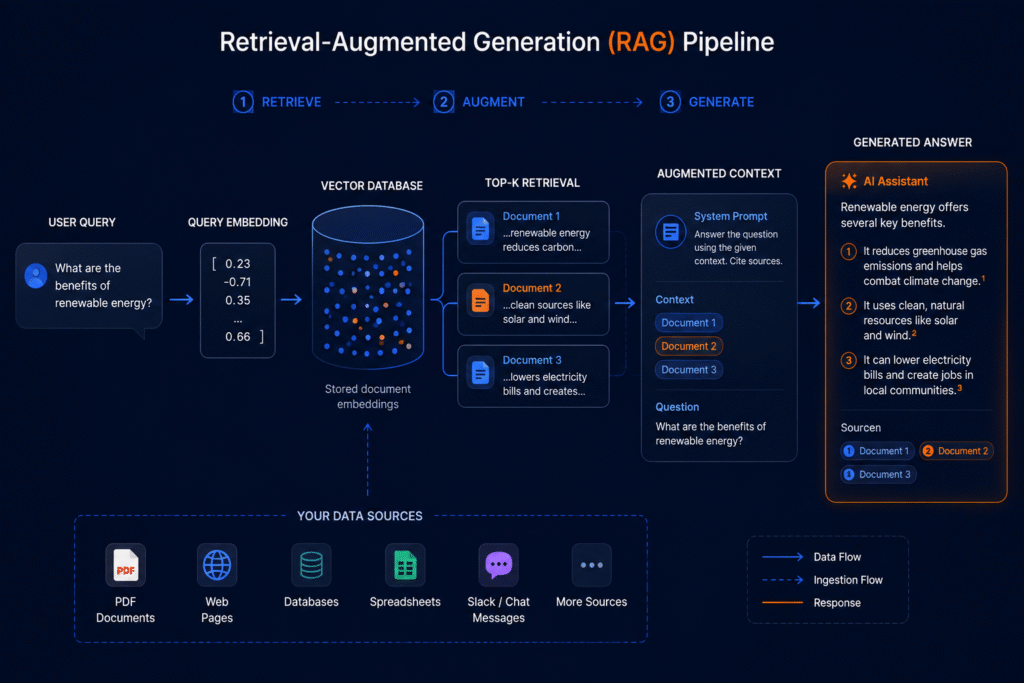
Generative Engine Optimization (GEO) is the practice of structuring, writing, and formatting your brand’s digital footprint so that AI search engines can easily retrieve, synthesize, and cite your information.
To understand GEO, you must understand how modern platforms like Perplexity AI, ChatGPT Search, and Google Gemini process information. They do not rely solely on simple keyword indexes. Instead, they use a process called Retrieval-Augmented Generation (RAG).
When a user asks a question, the RAG engine does three things:
- It queries the live web for relevant, high-quality sources.
- It processes those sources using vector embeddings and semantic search to understand the deep context of the pages, rather than looking for exact keyword matches.
- It synthesizes a single, conversational answer and inserts citations back to the source documents.
A 2023 academic study on Generative Engine Optimization conducted by researchers at Princeton, Georgia Tech, and IIT Delhi proved that optimizing content specifically for GEO variables—such as adding authoritative citations, structuring content with clear headers, and including statistical data—can increase a brand’s visibility in AI search results by up to 30% to 40%.
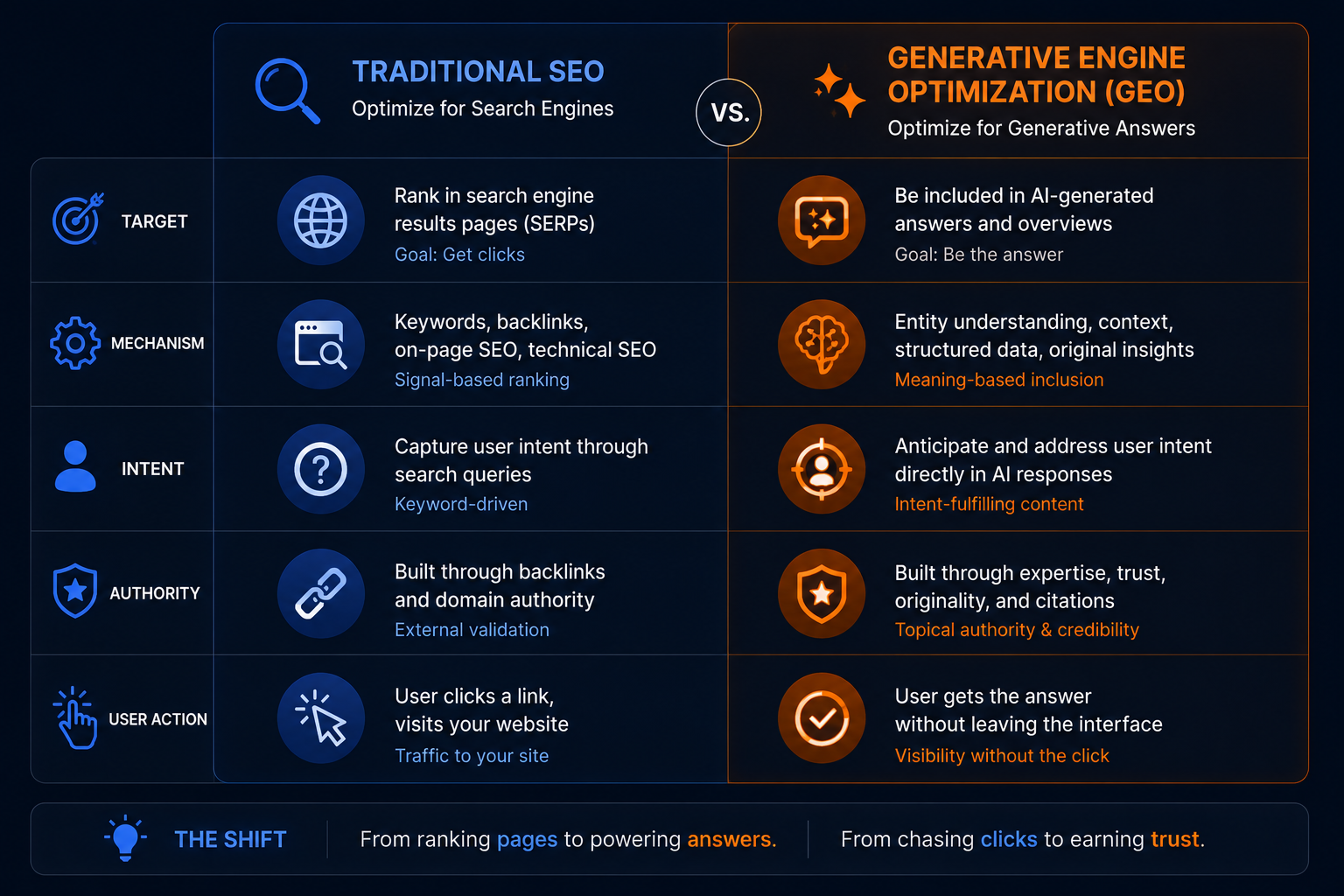
Traditional SEO vs. Generative Engine Optimization (GEO)
| Optimization Factor | Traditional SEO | Generative Engine Optimization (GEO) |
|---|---|---|
| Core Target | Search engine algorithms (Googlebot) | Large Language Models (LLMs) & RAG engines |
| Primary Mechanism | Keywords, page-level metadata, and backlinks | Vector embeddings, semantic search, and context |
| Search Intent | Match specific search terms | Solve complex, conversational, and multimodal search queries |
| Authority Metric | Domain Authority and link quantity | Google Knowledge Graph entity status and brand consensus |
| User Action | Click-through to a website | Direct consumption of synthesized answers with citation links |
How Do You Establish Brand Authority in Google’s Knowledge Graph?
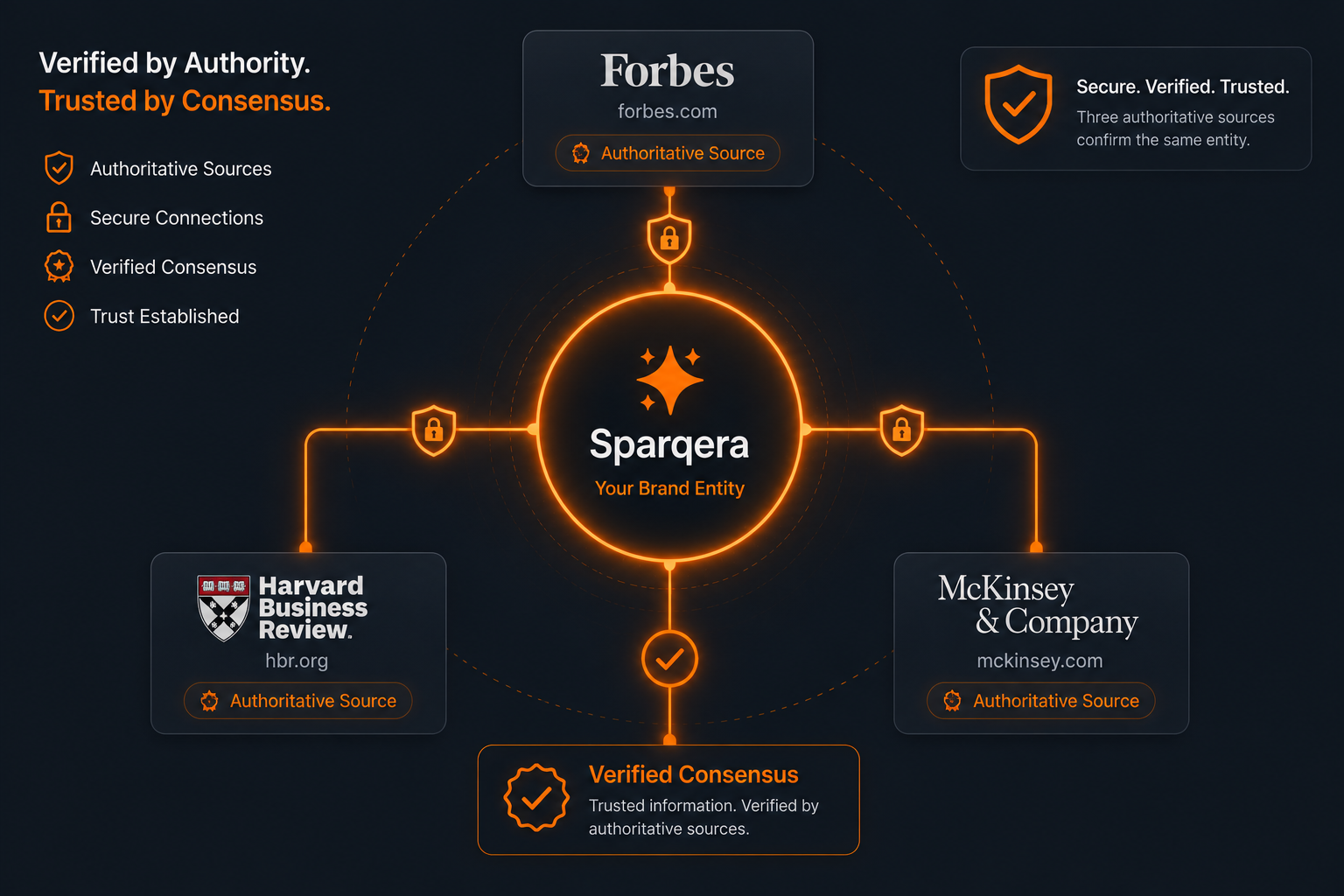
You establish brand authority in the Google Knowledge Graph by building consistent, unstructured mentions across authoritative third-party websites to create a clear consensus that AI models can verify.
AI models are trained to avoid hallucination by relying on consensus. If three authoritative, independent sources state the exact same fact about your brand, the AI engine is highly likely to treat that fact as truth and recommend it to the user. If your brand lacks this consensus, the AI will ignore you.
Think of it as digital PR with a technical twist. You are no longer just building links for “link juice”; you are building digital PR & brand citations to establish your entity relationship.
          Industry Publication A
                  │
                  │ Mentions
                  ▼
          ┌─────────────────┐
          │   Your Brand    │
          │     Entity      │
          └─────────────────┘
             ▲          ▲
             │          │
      Verified by   Connected to
             │          │
┌──────────────────┐  ┌────────────────────┐
│ Industry Pub B   │  │ Google Knowledge   │
│ & Review Sites   │──│ Graph              │
└──────────────────┘  └────────────────────┘
                           │
                           ▼
                 AI Search Engines
             (ChatGPT • Gemini • Perplexity)
Consider a hypothetical mid-market B2B software platform that wants to be recommended when a user asks ChatGPT, “What is the best payroll software for remote international teams?”
If the software platform only writes about payroll on its own blog, the AI will not recommend it. The platform needs to secure independent, third-party mentions on reputable platforms, review directories, and industry news sites.
When the LLM crawls those external sites and finds consistent, unstructured mentions linking the platform’s brand name to “remote international payroll,” it updates its vector space. The AI now associates the brand entity with that specific solution.
How to Optimize Technical SEO for AI Crawlers and LLMs
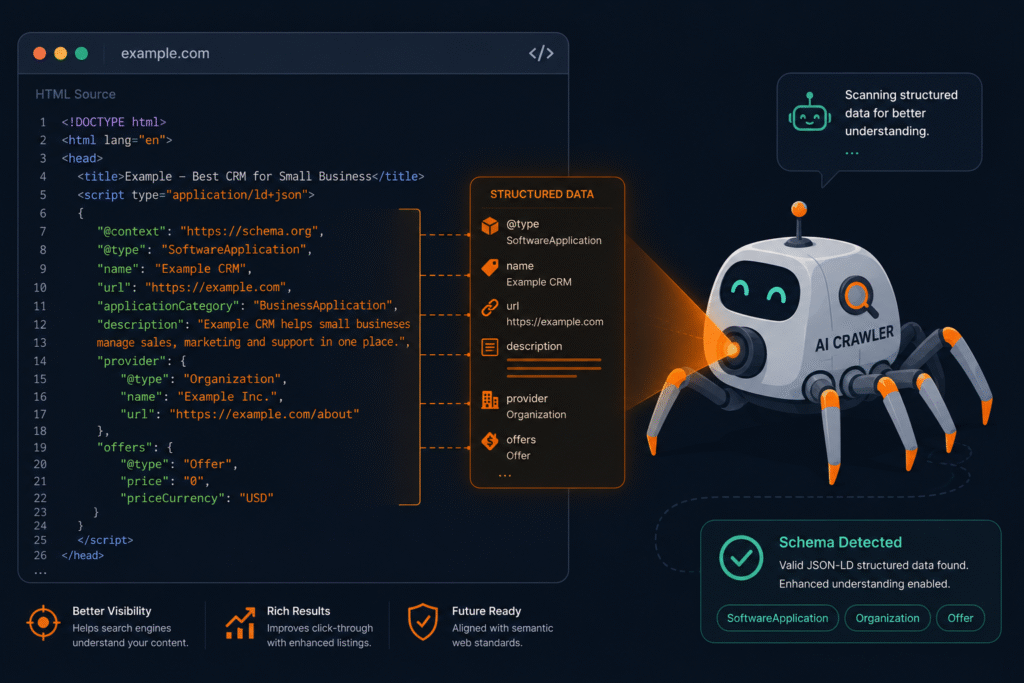
Optimizing technical SEO for AI requires three main steps: implementing advanced JSON-LD Schema, allowing AI crawlers in your robots.txt file, and optimizing structured product feeds for shopping assistants.
AI crawlers are hungry for structured data. If your data is messy, unstructured, or hidden behind complex scripts, the crawler will skip it.
1. Implement Advanced JSON-LD Schema Markup
Your website needs to speak the language of the database. Use advanced JSON-LD Schema to define everything on your site. Don’t stop at basic organization schema. You must implement schemas for:
Product(including real-time pricing, availability, and specific attributes)AboutPage(linking your brand directly to your social profiles and parent organizations usingsameAstags)FAQPage(providing clean, QA-formatted data for direct answering)ProfilePage(for authors, proving their real-world expertise to satisfy EEAT guidelines)
2. The Robots.txt Dilemma: To Block or Not to Block?
Many publishers, panicked over AI scrapers stealing their intellectual property, have updated their robots.txt files to block user-agents like GPTBot, PerplexityBot, and Google-Extended. This is a critical strategic mistake for commercial brands.
While blocking crawlers might protect informational media sites with paywalled content, for a business, blocking AI crawlers is brand suicide. If you block GPTBot, ChatGPT Search cannot access your site to verify your pricing, products, or services. You are effectively erasing your business from the search engines of the future.
3. Leverage Structured Product Feeds
AI search engines are increasingly integrating with transactional APIs. Google Gemini uses Google Merchant Center to pull real-time product data for shopping queries. Make sure your product feeds are updated daily, highly accurate, and fully optimized with detailed product descriptions, materials, dimensions, and shipping details.
📋 Free Resource
Download our free 2026 AI Search & GEO Readiness Checklist to audit your site for LLM compatibility, schema accuracy, and crawler accessibility. Download Checklist
Why Must Content Strategy Pivot from Informational Filler to Original Research?
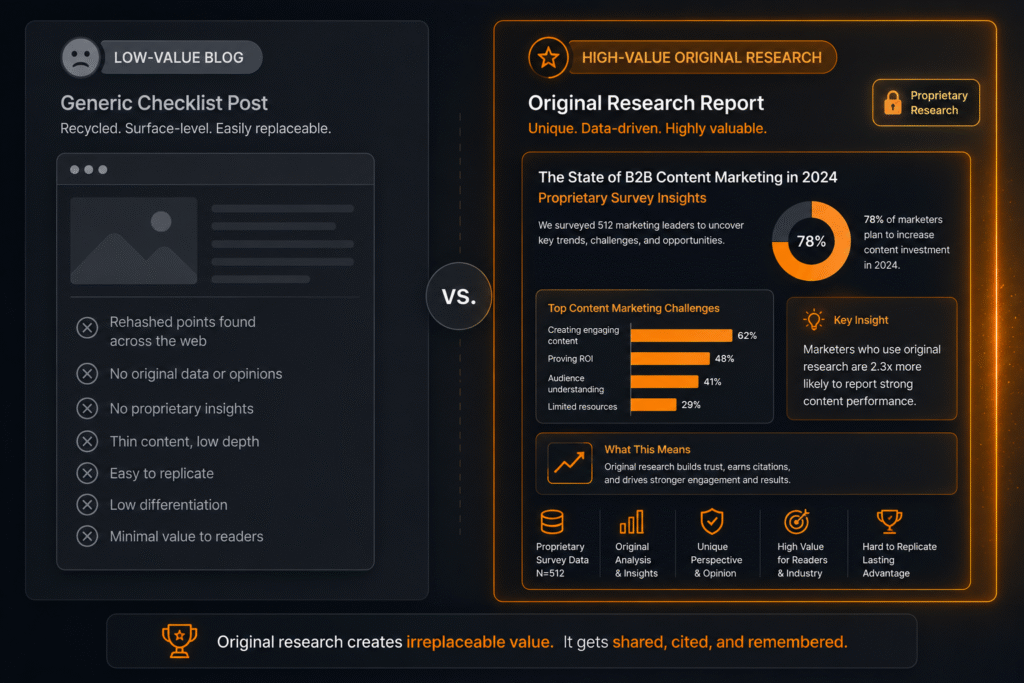
Content strategy must pivot because AI search engines instantly synthesize basic informational queries, making top-of-funnel (ToFu) definition articles obsolete and forcing brands to produce proprietary data, original research, and human-nuanced insights.
If your content strategy consists of writing articles like “What is digital marketing?” or “How to clean a leather jacket,” you are wasting your budget. AI search engines can write those basic definitions instantly, right on the search results page. No user will ever click on your 1,500-word definition article again.
To survive, you must pivot your content creation toward middle- and bottom-of-funnel assets that require human nuance, proprietary data, and real-world experience.
| Old Content Playbook (Obsolete) | New GEO Playbook (Thriving) |
|---|---|
| “What is…” definition articles | Proprietary data & original research surveys |
| Keyword-stuffed listicles | First-party case studies & step-by-step experiment logs |
| Aggregated generic tips | Opinionated, expert-led industry teardowns |
| Basic informational blogging | Interactive tools, calculators, and templates |
Focus on Original Research and Proprietary Data
AI cannot run a survey of 500 industry executives. It cannot share the internal data of how your company solved a specific technical challenge.
When you publish original research, unique statistics, and proprietary case studies, you create “link-worthy” and “citation-worthy” assets. When other websites cite your original research, they create the exact web consensus that AI search engines use to formulate their answers.
Build Interactive Tools and Gated Assets
Instead of writing generic informational guides, build tools. A mortgage calculator, a technical audit template, or a custom interactive parser provides utility that an LLM cannot replicate in a simple chat window. These tools attract highly motivated, bottom-of-funnel users who are ready to convert.
How Do You Measure SEO Success in the Era of AI Search?
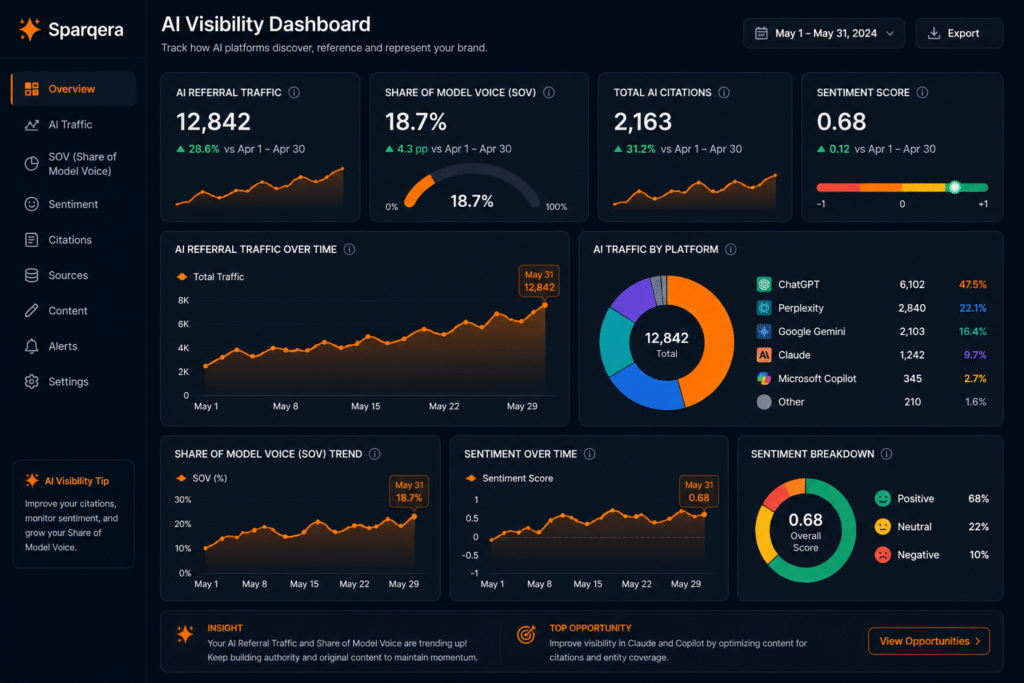
Measuring success in the AI era requires tracking AI referral traffic, monitoring your brand’s Share of Model Voice (SOV) in generative answers, and analyzing sentiment across unstructured brand mentions.
As traditional search traffic decreases, the traffic you do receive from AI citations will be different. It will be lower in volume, but it will demonstrate significantly higher conversion intent.
When a user reads a synthesized recommendation in Perplexity AI and clicks on your citation link, they are not browsing. They have already been vetted by the AI, and they are visiting your site to buy, sign up, or contact you.
To track success in this new landscape, update your analytics dashboards to monitor:
- AI Referral Traffic: Track referral traffic specifically originating from domains like
perplexity.ai,chatgpt.com, andgemini.google.com. - Share of Model Voice (SOV): Use modern GEO tracking tools to track how often your brand is cited in AI Overviews and conversational search engines for your target commercial queries.
- Brand Mentions and Sentiment: Monitor unstructured brand mentions across the web. Track whether the sentiment of those mentions is positive, neutral, or negative, as LLMs use sentiment analysis to determine which brands to recommend.
FAQ
Is traditional SEO completely dead because of AI?
No, traditional SEO is not dead, but it has drastically changed. Technical site health, page load speeds, and mobile usability still matter, but the tactical focus has shifted. Instead of optimizing web pages for a list of ten blue links, you must now optimize your brand’s entire digital footprint to be understood and recommended by AI models.
How do I optimize my website to get cited by Perplexity and ChatGPT?
To get cited by conversational engines, you must build brand authority across third-party sites to create a web consensus. Additionally, write your content in a clear, authoritative, and direct manner. Use structured data (JSON-LD), present clear factual statements supported by statistics, and make sure your website is easily crawlable by AI user-agents.
Should I block AI bots in my robots.txt file to protect my content?
For most commercial businesses, e-commerce brands, and service providers, blocking AI bots is highly counterproductive. If you block crawlers like GPTBot, ChatGPT Search cannot index your products or services, meaning your business will never be recommended to users searching for solutions through those platforms.
What is the difference between SEO and GEO (Generative Engine Optimization)?
Traditional SEO focuses on page-level optimizations (keywords, title tags, meta descriptions, and backlink volume) to rank in search engine indexes. GEO (Generative Engine Optimization) focuses on optimizing for LLMs. It prioritizes entity relationships, semantic context, data structure (JSON-LD), and brand consensus across the entire web.
How do I track referral traffic coming from AI search engines?
You can track this traffic in your web analytics platform (like Google Analytics 4) by filtering your referral traffic sources. Look for traffic coming from referrers such as android-app://com.perplexity.perplexity, chatgpt.com, perplexity.ai, or specific subdomains associated with generative search tools.
The landscape of search has changed permanently. The brands that survive the next transition will be those that stop writing for search algorithms and start building undisputed authority across the web.
Ready to See How Your Website Performs in AI Search?
Reading about AI Search is one thing—understanding how your own website performs is another.
Use Sparqera’s Free AI Search Visibility Audit to evaluate your website’s readiness for AI-powered search engines like ChatGPT, Gemini, Perplexity, and Google’s AI Overviews. Discover actionable insights into your brand authority, technical SEO, structured data, and Generative Engine Optimization (GEO) opportunities.