
From SEO to GEO: How AI Search Is Changing Digital Visibility in 2026
Your blog is ranking. Your impressions are up. But your traffic is quietly bleeding out — and you have no idea why.
This is the reality dozens of business owners and marketing teams in India are facing right now. They’re doing everything “right” — publishing blogs, building backlinks, optimizing keywords — and still watching their results flatten. The problem isn’t their effort. The problem is that the game has fundamentally changed, and most people haven’t been told yet.
Search is no longer just Google. And search results are no longer just links.
In this blog, you’ll understand exactly what’s happening to search, why your current SEO strategy is only half the battle, and what Generative Engine Optimization (GEO) means for your business in 2026. No jargon overload. No panic. Just clarity — and a clear path forward.
The Silent Shift Nobody Warned You About
Here’s something that should stop you mid-scroll.
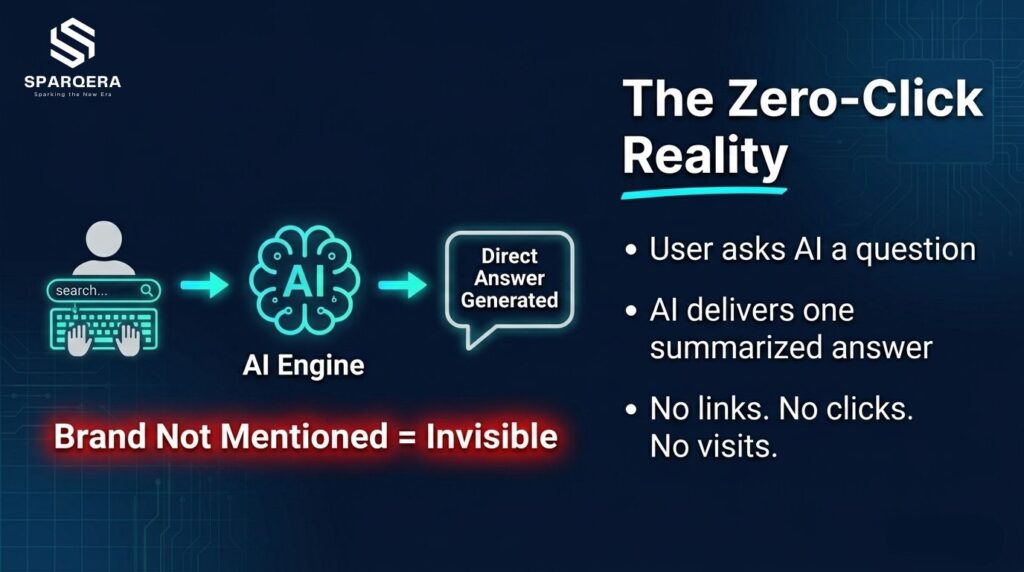
When someone types a question into ChatGPT, Google Gemini, or Perplexity today, they don’t get a list of ten website links. They get one synthesized answer — pulled from multiple sources, summarized cleanly, delivered instantly.
No links to click. No websites to visit. Just an answer.
This is what’s called a zero-click experience. And it’s not a glitch or a trend. It’s the new default behavior of millions of users worldwide — including your potential customers.
You’ve probably seen it yourself. Google’s AI Overviews now appear at the very top of search results, answering the user’s question before they even see the organic rankings below. Platforms like ChatGPT are being used the way Google was used five years ago.
The result? Even pages ranking in the top three positions on Google are getting fewer clicks than ever before. Businesses are getting impressions — but not visits. Visibility — but not traction.
This isn’t a content quality problem. It’s a search behavior problem. And the solution has a name: GEO.
What Is Generative Engine Optimization (GEO)?
Generative Engine Optimization (GEO) is the practice of structuring and positioning your content so that AI-powered platforms — like ChatGPT, Google Gemini, and Perplexity — select, understand, and cite your brand in their generated answers.
Think of it this way.
Traditional SEO helps you rank on a results page. GEO helps you become the answer itself.
When a user asks an AI tool, “What’s the best digital marketing agency for startups in India?” or “How do I grow my brand online?” — the AI doesn’t scroll through websites like a human. It draws from content it has already processed, verified, and deemed trustworthy. It synthesizes that into a response.
GEO is the discipline of making sure your brand is part of that response.
SEO vs GEO vs AEO: Let’s Clear the Confusion Once and For All
If you’ve come across the terms SEO, GEO, and AEO and felt confused — you’re not alone. Here’s a simple breakdown:
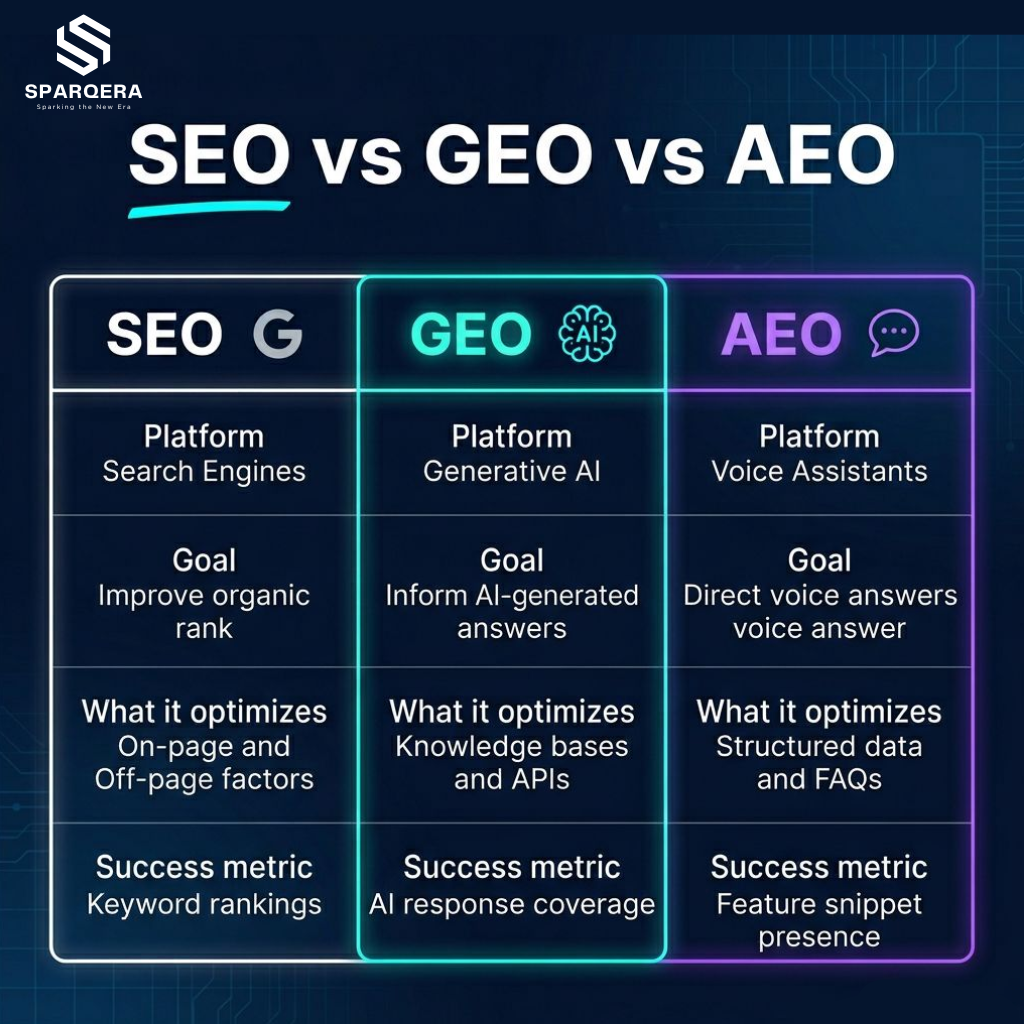
| Term | Full Form | What It Does |
|---|---|---|
| SEO | Search Engine Optimization | Helps your content rank on Google’s results page |
| AEO | Answer Engine Optimization | Helps your content appear as direct answers in featured snippets |
| GEO | Generative Engine Optimization | Helps your content get cited by AI tools like ChatGPT, Gemini, and Perplexity |
These aren’t competing strategies. They’re layers of the same foundation.
SEO is your base. AEO builds on it by making your content answer-friendly. GEO takes it further — ensuring your content is structured, authoritative, and consistent enough for AI models to trust and reference it.
If you’re only doing SEO, you’re playing a 2018 game in a 2026 world.
Why High-Ranking Blogs Are Quietly Losing Clicks
Here’s an observation that should make every business owner sit up:
Some of the best-ranking blogs on Google — pages that worked hard for their positions — are now generating fewer visits than they were two years ago. Not because they dropped in rank. But because users are getting their answers before they ever reach the website.
Google’s AI Overview answers the question right at the top of the page. The user reads it, gets what they need, and leaves. The blog that “ranked” never got a single click.
This is the hidden cost of ignoring GEO.
The businesses gaining visibility right now aren’t necessarily the biggest or the most funded. They’re the ones whose content is:
- Clearly structured — with headings, bullet points, and direct answers AI can easily extract
- Consistently authoritative — the same information appearing accurately across their website, social media, Google Business Profile, and third-party platforms
- Semantically deep — covering topics thoroughly enough that AI models trust them as a complete and reliable source
That’s GEO in action.
How to Start Optimizing for GEO: 5 Practical Steps
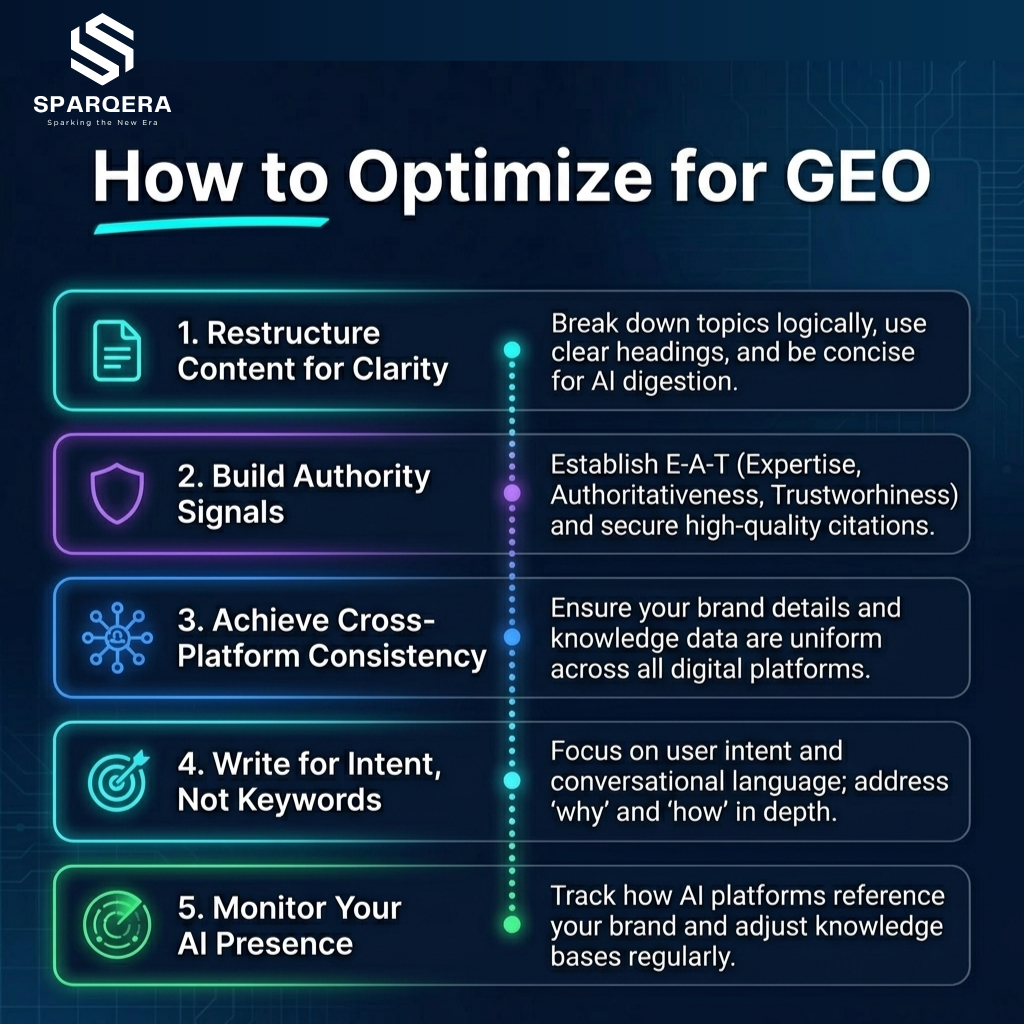
You don’t need to tear down your entire content strategy. You need to evolve it. Here’s where to start:
1. Restructure Your Existing Content for Clarity
AI models parse content the same way a smart, impatient reader does — they scan for structure. If your blogs are dense walls of text, they’re invisible to generative engines.
- Add clear H2 and H3 subheadings
- Use bullet lists and numbered steps where applicable
- Include a FAQ section at the end of key blogs
- Write a 2–3 line summary or “key takeaway” box at the start of long articles
2. Build Authority Signals Into Your Content
Generative AI rewards content that feels credible and expert. This means:
- Include author names and brief bios on your blogs
- Reference real data, industry standards, and verified insights
- Add testimonials, case results, or client examples where relevant
- Cite your sources — transparency builds trust with both humans and machines
3. Achieve Consistency Across Every Platform
One of the most overlooked GEO mistakes: your website says one thing, your Instagram bio says another, and your Google Business Profile is outdated.
AI models cross-reference your brand across multiple platforms. Inconsistency signals unreliability — and you get skipped.
Audit your brand presence across:
- Website (homepage, about, service pages)
- Google Business Profile
- LinkedIn, Instagram, and other active social profiles
- Directories, review platforms, and any third-party mentions
Make sure your brand name, description, services, and positioning are identical and accurate everywhere.
4. Write for Intent, Not Just Keywords
Keyword stuffing has been dying for years. In the GEO era, it’s completely obsolete.
What matters now is intent coverage — writing content that doesn’t just answer the main query, but anticipates the follow-up questions too.
For example, if you’re writing about “social media marketing for small businesses,” don’t stop at the basics. Also answer:
- How much does social media marketing cost in India?
- How long before social media marketing shows results?
- What platforms work best for small businesses in India?
This depth signals to AI that your content is comprehensive — and worth citing.
5. Start Monitoring Your AI Presence
Most businesses track Google rankings. Almost no one is tracking their GEO presence yet. That’s your competitive advantage — for now.
Start by manually searching your brand name and key topics in:
- ChatGPT
- Google AI Overviews (search your target queries on Google and observe what the AI block says)
- Perplexity
Are you being mentioned? Are competitors? This tells you exactly where the gaps are.
GEO Is Not the Future — It’s Already Happening
The businesses that will dominate search in the next three years aren’t waiting for GEO to become mainstream. They’re building for it now, while most of their competitors are still arguing about keyword density.
At Sparqera, this is precisely the shift we identified early. We’ve watched clients invest months into traditional SEO — building clean blogs, getting rankings — only to see impressions climb while clicks flatline. The content was good. The strategy was incomplete.
The fix wasn’t starting over. It was adding the GEO layer — restructuring content, strengthening authority signals, and ensuring brand consistency across every platform AI models reference. The result: content that doesn’t just rank, but gets cited in the answers users actually see.
That’s the difference between being on the search results page and being in the answer.
FAQ: Common Questions About GEO
Is GEO only relevant for big brands? No. In fact, niche businesses with focused expertise often have an easier time building GEO authority than large generalist brands. If your content clearly covers a specific topic with depth and consistency, AI models will recognize it — regardless of your company size.
Do I need to stop doing SEO to focus on GEO? Absolutely not. SEO and GEO work together. A well-optimized, technically sound website is the foundation that makes GEO possible. Don’t abandon SEO — evolve it.
How long does GEO take to show results? GEO is a medium-to-long-term strategy, similar to SEO. Structural changes to content can have relatively quick impact on AI Overviews, while broader citation authority builds over weeks and months.
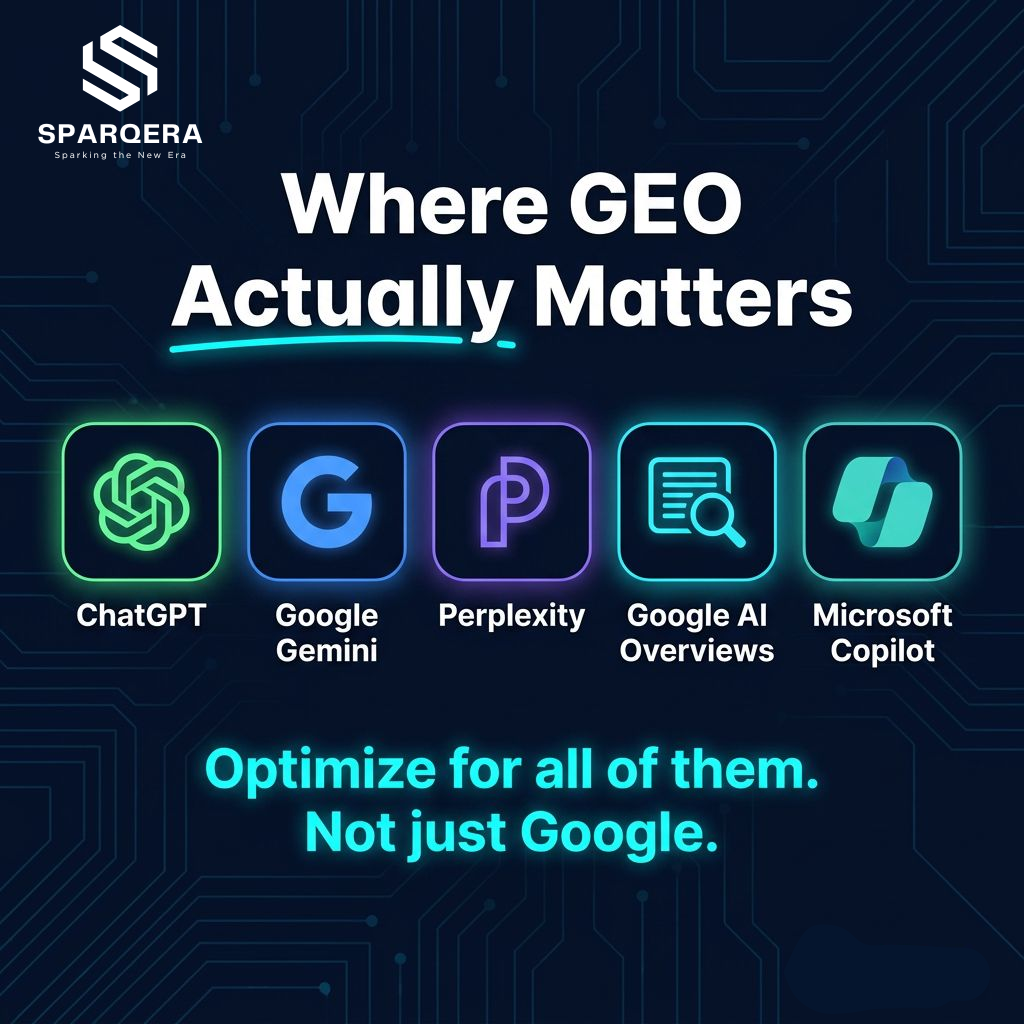
What platforms does GEO target? ChatGPT, Google Gemini, Google AI Overviews, Perplexity, Microsoft Copilot, and any other AI-powered search or answer tool.
What’s the first GEO step for a small business? Start with a content audit. Review your top five performing blogs or pages and restructure them — add clear headings, FAQ sections, and ensure your brand information is consistent everywhere online.
Internal Linking Suggestions
| Link From | Anchor Text to Use |
|---|---|
| “What is SEO?” or beginner SEO guide | “how GEO builds on traditional SEO” |
| Content marketing strategy blog | “generative engine optimization” |
| Any blog mentioning Google AI Overviews | “how to appear in AI-generated answers” |
| Digital marketing for startups content | “GEO for small businesses” |
| This blog → outlinks | Link to your content audit service, free strategy call page, or a related blog on E-E-A-T |
Conclusion: The Brands That Adapt Early Will Own the Answer Layer
Here’s the honest truth: if your business is still relying only on traditional SEO, you’re already behind — not because you did something wrong, but because the landscape moved while most people weren’t watching.
Search behavior has changed. Users want answers, not links. And AI platforms are now the ones deciding which brands get to provide those answers.
The good news? Most of your competitors haven’t figured this out yet. That’s a window — and it won’t stay open forever.
To recap what you’ve learned:
- Zero-click searches are real and growing — impressions without clicks is the new normal for brands ignoring GEO
- GEO, SEO, and AEO are complementary, not competing — you need all three
- AI models reward content that is structured, trustworthy, semantically deep, and consistent across platforms
- You don’t need to rebuild from scratch — you need to evolve what you already have
The shift from SEO to GEO isn’t something that’s coming. It’s already here.
It’s time to optimize not just for Google — but for AI.
If your brand is ready to stop chasing rankings and start showing up in the answers your customers are actually seeing — connect with Sparqera today.
Let’s audit your current content strategy and build a digital presence that’s ready for the era of AI search.
Great content! Keep up the good work!